THE GROUP HEXLappies |
Katrina Mokwena (leader) Nicky Nyanga
Linda Botes , Sally Matolla, Sophia Killian, Elizabeth van Wyk, Hendritta van Eick , Nicky Olivier, Sanna Titus. Beverley Ranchod, Rina Willemse, Erica Lüttich (co ordinator) Katherine Low (researcher) |
HEXLappies, a group of grandmothers, mothers and daughters co-create together in De Doorns in the old jail building on the N1, the national road. De Doorns is situated in the Hex River Valley, South Africa.
We meet once a week on a Wednesday to share our ideas, listen to each other and find ways to connect our concerns that affect families and the well-being of our town. When we are very busy we connect twice a week, to create more blankets or work on projects that have meaning for the group.
The participants all live in a neighbourhood called Scotland, and they can walk to the old jail if they come together. To walk alone is not very safe at all. It is about a kilometre to the centre where we meet but there is an open field that the women have to walk through which is unfortunately not safe.
Our approach is to share, to listen and the making of artefacts that both speaks about the environment, about the availability of material, the specific choices we make that impacts our lives and how can we make a difference. We use craft, embroidery, knitting to co-create, but we also participate in environmental issues, for example participating in the Stitches4Survival Campaign at COP 26 in Glasgow. We participated in clean up attempts around De Doorns to collect and clean designated areas of rubbish, paper and plastic. We are makers, we are practical and share our skills with each other so that the learning is inclusive, keeping pace with each individual and we laugh a lot.
This project started in May 2020 under the heavy Covid-19 Lockdown regulations we experienced in South Africa. There was a need for the primary caregivers, the mothers and grandmothers of the town, to find a space to share their stories. These initial Wednesday meetings was to offer each other support and engage in skills development that was connective and inclusive. The environmental awareness grew out of these first meetings and the conversations was about our space, our own backyard and what is our responsibility. This isa journey that is intuitive, is about each individual and although choices are constantly made it is not prescriptive and not about deadlines. These women experience various pressures at work, at home and in the social construct that women have to abide by. Our space is about a learning, experiential and inclusiveness and creating which allows for social justice interventions to be explored.
Over the last 2 years the project has developed strong commitment to each other, to the respective families,but also to each other. The learning and sharing has become based on respect, sharing creative skills and that making a blanket, or cleaning a street is all our responsibility. We engage with events in our town to support the Senior Home, we knit hats for a burn unit at a children’s hospital, we knit blankets for an orphanage. We select various ways to offer support, be pro-active and use our skills to benefit those around us. We are connected, we are committed and we want to participate in this valley.
We created several short films at the end of 2021, and feel that these films speaks about the impact we have on each other, the influence of positive engagement. We created a project that has trust and willingness to tackle the complex issues we as a country faces every day. We speak about our colonial history, about slavery,about the impact that we humans have on the environment. We raise the concerns of violence against women and children, (engaging in the 16 days of Gender Based Violence against Women and Children), we try to find ways to create interventions that is specific and can reach people around us. Both our Instagram and Facebook pages have grown, and we use these platforms to voice our concerns, our experiences and that we are making a contribution to our immediate surroundings.
We do experience the shortage of material and equipment for all the resources we need. But we learned that we need to use what we have, what we want and what we need are separate issues and the future on this planet is precarious and that need versus want is part of the dilemma on earth. We can build awareness and should play a role in how we want the future to be for all of us.
See here short videos about the group
One year of ProjectThe year so quickly came to an end, sneaked up on us as we still hoped to achieve so much more. The export grape season has started in the Valley during September, which meant that many women had to go and work,as this is the only income they have for a few months. The season ends in April/May depending on the grape variety.
During our collective time together we participated in two projects, on Gender Based violence, a huge issue in our country. We embroidered onto re-purposed cloths from fabric sample books and created 2embroideries that speak directly to what we do not want in our lives, and 2 embroideries to share what we like, want and need. During the wintertime we knitted several panels for #stitches4survival for the COP 26 conference on climate change, Glasgow, United Kingdom. We were so eager to knit panels, and we have used recycle and donated wools, rope, plastic and left over bits and created the Hex River in our valley. When we stitched the panels together, we realised that the postage to send these panels to Glasgow would be too expensive and had to send a short film that we made on our craft protest for the conference. As this is the only work in the Hex Valley for most women and there are no choices, and we accept that currently this is the situation, and we make way and space for our fellow participants. We started an instagram page @hex_lappies, which Nicky Nyanga is managing for us. We have a facebookpage, which we try to keep updated when we have data available:https://www.facebook.com/groups/583736499020913
|
A small group that did not go to the work, some only start in January 2022, insisted on still meeting and decided to make blankets from recycled material. The women wanted to learn to quilt and are making these blankets as a possible income opportunity. So we gathered what we have between all of us to re-purpose,recycle and re-use, as this is still a core focus to our crafting process. Nicky Nyanga found several designer fabric sample books on a landfill site close to her home and after many washes and drying in the sun but also tea-dying experiments to create a distress fabric feeling we have now put together 5 blankets as part of an experiment. Unfortunately, we did had to buy cotton for the sewing machine as well as the inside soft fabric to make the blankets warmer. It has been a very positive experience to collectively work on these ideas and patterns, and some really tried to make unique colour combinations as well as really use the fabric they like,choose the colours and textures that feels close to there hearts. Katrina Mokwena decided to make a blanket for her youngest son and chose the cotton fabric that was a donation from a sheeting company. The white cotton were coloured with left over chemical dyes from previous workshops several years ago (2016-2018) and has many colours from yellows to oranges, reds,blues and greens. She created several blocks and rows and also learned to work on a sewing machine. We received a donation of an old Bernina 910 (1986 model) and this created an opportunity for new lessons, new learning and new skills. Nicky Nyanga found several books of beautiful upholstery fabric strewn in and around the veld and a landfill site. These, which needed much washing and drying in our strong sun, took weeks to loose all the marks and smells. With this she created a blanket that explored several layers of textures and muted colours of brown,green and blues. She has sewing machine experience and therefore stitched her blanket together but also helped with both Katrina Mokwena and Linda Botes’s blanket. This was very helpful to have the guidance but also another voice to explore and interrogate choices, colours and creativity. Linda Botes created a blanket from cotton and linens from the resources we had. She selected a series of prints, floral patterns and created a blanket with olive greens, deep browns. With the help from Nicky Nyanga she created 8 blocks from a design she found in one of our small library of resource books. These books and magazines were donated to each from several members from our immediate network of supporters and helps with inspiration and learning new techniques. |
Textile Squares in the travelling Exhibitions: Cairo 2022; Portugal|Spain 2023; Brazil 2023
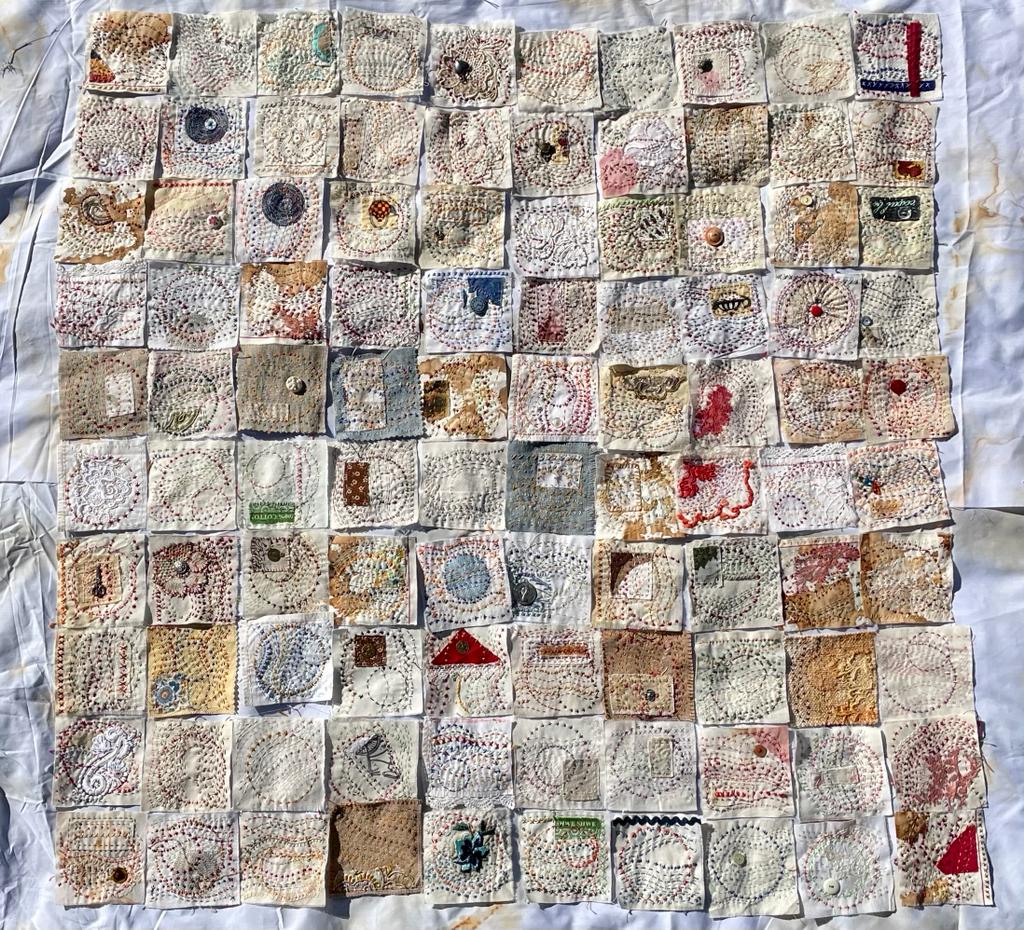
HEXLappies- 9 cloths from 9 women for the Exhibitions in Portugal
In my memory, when I was at school (1970-1981), I learned that a man was allowed to walk for a day and then this land he walked during that time frame would belong to him. It was presented as a noble course and the right of man to own land. I was never taught that people lived on this land. I was never taught the Land Act of 1913.[1] These were the stories re-told carefully again and again so that the narrative of South Africa was always in favour of the man, the righteous religious conqueror. I only realised by age sixteen (1980) that something was wrong. By then it was too late.
I live in the Hex River Valley in the Western Cape, South Africa. Here I have since 2020 worked together with a group of women who live in Stofland, one of the suburbs in De Doorns where predominantly people of colour live. Despite our birth of democracy in 1994 the urban geography is still based on the Apartheid era philosophy. This schism in the ownership of land is problematic and has led to poverty, food security issues and access to generational wealth for most families.
We live in an area where agriculture is the main and predominant produce, labour employer and export grapes the only economically viable option. The degradation of the natural landscape is visible and water scarce. During 2013-2018 the drought severely affected everyone in the Western Cape.
During 2006/2007 families were informed to apply for a piece of land 10m x 10m in Stofland. Some had to wait as long as 6 years and some longer to actually have ownership of this land and a small house. These are the women, mothers and daughters that I have created artwork and developed conversations around the natural habitat, our responsibility and commitment. Finding solutions for our future is complex and we engage with as many local projects to improve our general well-being.
These 9 pieces of cloth that measures 10cm x 10cm is a direct response to the land issue in our country. The calico was off-cuts, the thread the small pieces that we collected every day from the floor. These were the remnants of our daily craft work and these small bits were worked into these squares whilst we talked about the issues at hand, the violence women endure, the degradation of the environment, the legacy of inequality for centuries that we still experience.
HEXLappies 2021
[1] The Act became law on 19 June 1913 limiting African land ownership to 7 percent and later 13 percent through the 1936 Native Trust and Land Act of South Africa.
https://www.gov.za/1913-natives-land-act-centenary
MAPPING
Mapmaking Hex River Valley June 2022
Erica Lüttich
Maps disseminate information that might be useful and or not at all. The way we ‘see’ maps today was determined by the mapmakers of the 13th century and as these mapmakers were based in Europe, they centred their own place/space and the current world map is perceived to be with Europe at the top and Africa generally at the bottom. But as most countries even the ancient Greeks centred their worlds it is part of a strange form of nationalism that prevails in many parts of the world.
Story telling is very much part of mapmaking history as many people would return from journeys and tell the tales of their experiences. So, this mapmaking was a visual as well as geographical record of time, travels and stories.
How can we create our own maps that will underpin our stories, our lived experience in the current violent environment? In the Hex River Valley only grapes are produced which is a monoculture and holds much fear for the future of climate change. As it is the only possible employer of mostly seasonal workers it is not something that will be adjusted and or change soon. Although artists are constantly raising the issue of various climate change narratives, these are not in the mainstream of conversations nor are any producer looking at alternative produce to cultivate. Furthermore, the fruit fly has been eradicated from the valley which the Cape Dwarf Chameleon relies on for food and therefore these small reptiles cannot be found in its natural habitat anymore, the status is near extinct.
How do we create a map that addresses our needs and records our story? But starting to create maps that can be combined to introduce a bigger map that does have relevance to us living here. By taking our points of interest, be they generational, experiential or telling a story we can narrate a map that is of value to us and our families.
Maps are a 2-dimensional representation of our world, that is a circle, and rotates around its own axel. This flat version of our world consists of many distortions and variants. One way of being able to map out our world is by creating a sculpture, a 3-dimensional version of our spaces. And this is where our journey started with Lauren Low, a master’s student from the Royal Central School of Speech and Drama. During June 2022, she spends 4 weeks with us to introduce us to new ideas, inspiring ideas including puppetry, mapmaking, and facilitating alternative ways to connect and activate our spaces.
Lauren posed many questions:
1. Showed a series of maps ask many questions?
2. What and who is represented in these maps?
3. What information can we gather from these examples?
4. Can we learn from these maps?
5. What does maps do and how can we create our own maps?
Using items, some recycled, some containers from our lunch we created a space that has familiarity, is known to us and follows our footpaths. This conversation had to be negotiated, explored and shared to be inclusive. The next step was to re-draw this spatial map onto paper and add the detail, the nuances and the stories of our world. The map created by the women informed us about spatial geographies, unjust service deliveries, how the resources are still unequal and the fact that there are very few safe spaces for children to play safely.
Partly this mapmaking workshop was also intended to identify community resources, understanding a sense of place and belonging, and more importantly to evaluate the resources available to people living in the area.
Here follows a few translations from the women who participated in this mapmaking workshop:
Erica Lüttich
Maps disseminate information that might be useful and or not at all. The way we ‘see’ maps today was determined by the mapmakers of the 13th century and as these mapmakers were based in Europe, they centred their own place/space and the current world map is perceived to be with Europe at the top and Africa generally at the bottom. But as most countries even the ancient Greeks centred their worlds it is part of a strange form of nationalism that prevails in many parts of the world.
Story telling is very much part of mapmaking history as many people would return from journeys and tell the tales of their experiences. So, this mapmaking was a visual as well as geographical record of time, travels and stories.
How can we create our own maps that will underpin our stories, our lived experience in the current violent environment? In the Hex River Valley only grapes are produced which is a monoculture and holds much fear for the future of climate change. As it is the only possible employer of mostly seasonal workers it is not something that will be adjusted and or change soon. Although artists are constantly raising the issue of various climate change narratives, these are not in the mainstream of conversations nor are any producer looking at alternative produce to cultivate. Furthermore, the fruit fly has been eradicated from the valley which the Cape Dwarf Chameleon relies on for food and therefore these small reptiles cannot be found in its natural habitat anymore, the status is near extinct.
How do we create a map that addresses our needs and records our story? But starting to create maps that can be combined to introduce a bigger map that does have relevance to us living here. By taking our points of interest, be they generational, experiential or telling a story we can narrate a map that is of value to us and our families.
Maps are a 2-dimensional representation of our world, that is a circle, and rotates around its own axel. This flat version of our world consists of many distortions and variants. One way of being able to map out our world is by creating a sculpture, a 3-dimensional version of our spaces. And this is where our journey started with Lauren Low, a master’s student from the Royal Central School of Speech and Drama. During June 2022, she spends 4 weeks with us to introduce us to new ideas, inspiring ideas including puppetry, mapmaking, and facilitating alternative ways to connect and activate our spaces.
Lauren posed many questions:
1. Showed a series of maps ask many questions?
2. What and who is represented in these maps?
3. What information can we gather from these examples?
4. Can we learn from these maps?
5. What does maps do and how can we create our own maps?
Using items, some recycled, some containers from our lunch we created a space that has familiarity, is known to us and follows our footpaths. This conversation had to be negotiated, explored and shared to be inclusive. The next step was to re-draw this spatial map onto paper and add the detail, the nuances and the stories of our world. The map created by the women informed us about spatial geographies, unjust service deliveries, how the resources are still unequal and the fact that there are very few safe spaces for children to play safely.
Partly this mapmaking workshop was also intended to identify community resources, understanding a sense of place and belonging, and more importantly to evaluate the resources available to people living in the area.
Here follows a few translations from the women who participated in this mapmaking workshop:
|
The first question asked was what did I learn from this map?
What do we want to say with the information gathered? How can we inform ourselves and others with this information? I realised that the mountains are so beautiful, and this map made me re-look at them in a new light. When I look from the mountains to where we live, I realise that we have very few homes and mostly have many shacks, or as we say in Afrikaans, ‘hokke’. It made me realise that we do not have enough houses for the people to live in. There are many vineyards, and this is where we find work. The roads in our area are dusty, full of holes, difficult to navigate and have to many stones. My worry is the graveyard situated where we live. There are footpaths, lots of rubbish and the children use it as a playground. This is the place where people come to rest after death, and now everyone walks across, leave their rubbish and play on the tombstones. These people are dead and buried here, yet we are living amongst them. In our area there are no safe play spaces for children. People continuously dump their rubbish everywhere and we constant have water running in the streets. This is called ‘sigwater’ in Afrikaans, or surface water. The dumping of rubbish causes the waterways to be blocked and now the water runs freely in our streets, into our yards. When I look at the map, I remember where I live, my house, my people and family, living around me on paper. Seeing my life on a map was important to me. Sophia Killian |
I always knew how important the N1 was as it transports all the food with trucks between Cape Town and Johannesburg. But I only realised the significance of this when we created this map. The impact that this road has on my life and that my heart lies on this road. It takes me home (towards the South) to my family in Cape Town and when I go North to my family in Touwsriver, or beyond to the Karoo, Laingsburg. I use this road constantly and it reminds me of my journeys. The mountains were one of my motivations to live here, I can meditate, walk there, take my dogs for a walk, and it is the reason I live here.
I learned from Lauren how important mapmaking is as well as the author of the map. The knowledge that I gained how to use mapmaking but also how it can be used as well as the affect this can have on out lives. I am amazed as how my perceptions altered when we created this map and the importance of the N1 and the natural beauty that we are surrounded by. The mapmaking workshop also highlighted to me what we lack in our town, no public rubbish bins, no green spaces, no safe spaces for children to play. And no public dumping sites, everyone just uses any space without any consideration for their neighbours. In De Doorns the main source of employment is working as farm labourers preparing, harvesting and packing of the export table grapes. We, the majority of people in the Hex River Valley, depend on this seasonal work to survive. All of us have worked on these farms in various capacities however I find it peculiar that not one of us included this major source of income, the only employment available to most of us on our map of De Doorns. I have a few thoughts on this. It could be that we wanted to exclude the vineyards in order to show we are more than just the table grapes that De Doorns is known for. Or we are tired of having this as our only source of income and by not including it we are hoping for change, but we have no idea what these possibilities are as we do not have the capacity to influence these decisions. Nicky Nyanga Co-facilitator, HEXlappies |
We learned that a map is never the same for every person. No map is wrong, and it is about your own experience. For me the mountains are important as this anchor me in this place. I think it is important that we do something about the ugly spots where we live. The rubbish on the N1 (a national road) that just lies around. One cannot find a path through the rubbish. This is awful and so ugly. People uses the rubbish dumps as toilettes, there are broken glass bottles and dead animals lying around.
This is a very worrying problem, and I wrote a poem about this:
I believe that I am not the only person
who finds the dumping of rubbish
anywhere quite annoying.
I know that if you teach your kids
to clean up behind them,
it won’t be such a problem.
I want the municipality
to put up notice boards
and give out warnings
to anyone who makes themselves
guilty of such misbehaviours.
I hope we will find a solution
in the near future,
because I can’t bear the thought
of my grandkids playing in a dumping site.
The total ignorance
about the act of dumping makes me
want to break a few things.
Marlene Baker
This is a very worrying problem, and I wrote a poem about this:
I believe that I am not the only person
who finds the dumping of rubbish
anywhere quite annoying.
I know that if you teach your kids
to clean up behind them,
it won’t be such a problem.
I want the municipality
to put up notice boards
and give out warnings
to anyone who makes themselves
guilty of such misbehaviours.
I hope we will find a solution
in the near future,
because I can’t bear the thought
of my grandkids playing in a dumping site.
The total ignorance
about the act of dumping makes me
want to break a few things.
Marlene Baker
|
I live in De Doorns for the last 7 years, but our place has not changed at all. If there will be changes in the services delivered to us it will prevent our children from getting various illnesses. So let us try to clean up the rubbish for our children and for the older generation so that we can be healthy and live in a clean space.
For me the biggest problem after I worked on this map was the pigs, goats that lives in the fenced of places in the mountains. These pigsties are not cleaned by the owners, nor maintained at all. In the summer the stench and the flies are awful. It is a real health hazard to all of us. Even in Winter it is now a problem for us living close to these ‘kraals’ or fenced animal places. I drew Petra College, the old Prison in De Doorns, as it is the place that I feel happy to come to. It is important to me as I learn, experience joy and I feel that I have a value here that is recognised. I meet people, I learn new skills and I am happy when I am here as I learn from the women here at HEXlappies. Simoné Ruiters |
The Engen Garage is important for all the busses and taxis who stop here to collect and drop passengers who are visiting us, family members and friends. The railway line holds a special place for me as it takes me to Kimberley. As a young woman I use to travel on the train to visit Andrew, my husband’s family who lives there. As a young newly married woman I used to take my new-born children to his parents to show them their grandchildren. That is why Kimberley holds a special place in my heart and I had to draw it on our map.
My children can easily get to the High School from our home and that is of great value to our family. There are subways under the N1 which makes it safe for them to get to the school. And I love the mountains, they are incredible and of great beauty to our valley. It gives us water when it rains, snow in winter to re-plenish the underground water supply to the De Doorns. Katrina Mokwena. I am 52 years old. Leader, HEXlappies |